Wednesday, 19 April 2017

AEX 301 Extension Methodologies and Transfer of Agricultural Technology (1+1)

OBJECTIVE QUESTIONS
Choose the best answer
1. Medium through which information flows from sender to receiver ______________
a. Communication
b. Channel
c. Treatment
d. None of the above                                                 

2. Which is the individual contact method ____________
a. Flag method                       
b. Method demonstration      
c. Campaign   
d. Exhibition                                                              
3. Behavioral theory of communication model also known as ________________
a. Leagans model       
b. Berlo model      
c. Shannon and Weaver model          
d. Schramms model                                                         

4. The word Huddle system is also known as ____________
a. Role play    
b. Brainstorming        
c. Workshop   
d. Buzz session                                                          

5. Face to face contact by extension worker with farmer to build rapport in _____________
a. Result demonstration
b. Method demonstration
c. Farm and Home visit
d. Campaign                                                             

6. Communication derived from the word _____________
a. French       
b. Latin         
c. Greek        
d. None of these                                                       

7. Classification of extension methods according to use _____________
a. Group contact       
b. Spoken   
c. Visual        
d. Written                                                                 

8. Person directly influencing the farmer’s decision within the social system
a. Personal cosmopolite        
b. Impersonal cosmopolite
c. Personal localite    
d. None of the above                                                

9. Information from one’s virtue of status to others is ___________ communication
a. Informal communication                
b. Formal communication                  
c. Zig Zag communication                 
d. Grapevine communication 

10. Seeing is believing is the principle behind                                   
a. Result Demonstrations                   
b. Exposure visit                    
c. Field days               
d. None of the above 

                                              
Fill in the blanks
  11.            Informal channel of communication also called as ________________
  12.            S-M-C-R-E model  was given by _______________
  13.            Classification of extension teaching methods according to their use and form was given by _______________
  14.            Devices used to create situation in which communication can take place between an instructor and learner  is called ______________
  15.            A small group interaction designed to encourage the free introduction of ideas on an    unrestricted basis and without any limitations to feasibility is called  ____________
  16.             Results of ________________ can be used only to rectify future programmes.  
  17.            __________________ is given before a group to show how to carry out an entirely new practice or old practice effectively.                              
  18.            Classification of Extension Teaching Methods according to their use and form was given by________________.      
  19.             ‘Learning by doing’ is the principle of ___________   
  20.            Information moves from lower level to higher level in organization is ______________.  
  21.            __________________ Model is based on behavioral science.  
  22.            Agricultural clinics is a ____________________ contact method.
  23.            Programme planning process is of _____________ steps.   
  24.            If a person communicates from outside the social system, it is called ______________ communication.         
  25.            Result demonstration is done by ________________          
  26.            Judging the value of a project before it is implemented is called _____________    
  27.            __________ is a place where discussion happens.    
  28.            Informal communication is otherwise called as ___________________ .
  29.            Vertical communications are _________________ communications.   
  30.             Continuous and symptomatic analysis is called ______________.
True or False
  31.            Learning by doing is the principle held by result demonstration   
  32.            Buzz session otherwise called as Phillips 66    
  33.            Information which is not relevant to a particular set of audiences is called noise.
  34.            Noise is reduced by a process called feedback.
  35.            Farm and home visit are examples of group contact methods.
  36.            The purpose of treatment is to make the message clear, understandable and realistic to audience.
  37.            In lecture an extension worker shows how to do a job step by step.   
  38.            The extension agent and mass media are sources or originators of message
  39.            A method demonstration is conducted to show how to carry out a new skill
  40.            Formal evaluation uses personal ideas instead of standard measurements. 
  41.            Programme planning helps to identify the gap between the present situation & the desired situation
  42.            Individual contact helps in teaching complex practices
  43.            The person who start the process of communication is called an Audience  
  44.            Monitoring is a continuous process that starts and ends with project. 

  45.            Radio is a visual extension tool   

Thursday, 13 April 2017

AEX 301 Extension Methodologies and Transfer of Agricultural Technology (1+1)

DESCRIPTIVE QUESTIONS

  1. Classify extension teaching methods as given by Wilson and Gallup.
  2. Classify the types of communication
  3. Draw the Berlo’s model of communication
  4. Draw the Extension communication model
  5. Explain Brain storming and its advantages
  6. Explain the elements of Communication as given by Leagans
  7. Explain the steps in programme planning
  8. Mention four advantages of Farm and Home visit.
  9. What are the advantages of Individual contact methods
  10. What are the barriers to communication
  11. What are the basic functions of communication
  12. What are the characters of a good message
  13. What is a campaign
  14. What is a Panel and what are the different types of panels
  15. What is meant by buzz sessions.
  16. What is result demonstration and how will you conduct it.
  17. What is the importance of programme planning
  18. What is the purpose of an exhibition
  19. Write about the advantages of Group contact methods
  20. Write about the degrees of evaluation
  21. What are the types of barriers in communication
  22. What are the advantages and limitations of exposure visits
  23. Briefly explain exhibitions
  24. What are the limitations in conducting a group meetings
  25. Explain role playing


Sunday, 1 January 2017

Dimensions of Agricultural Extension - Student evaluation survey


Hi!!!!!!!    II B.Sc (Agri) students


please click on the link given below and take up a survey for evaluating the course 


Monday, 17 October 2016

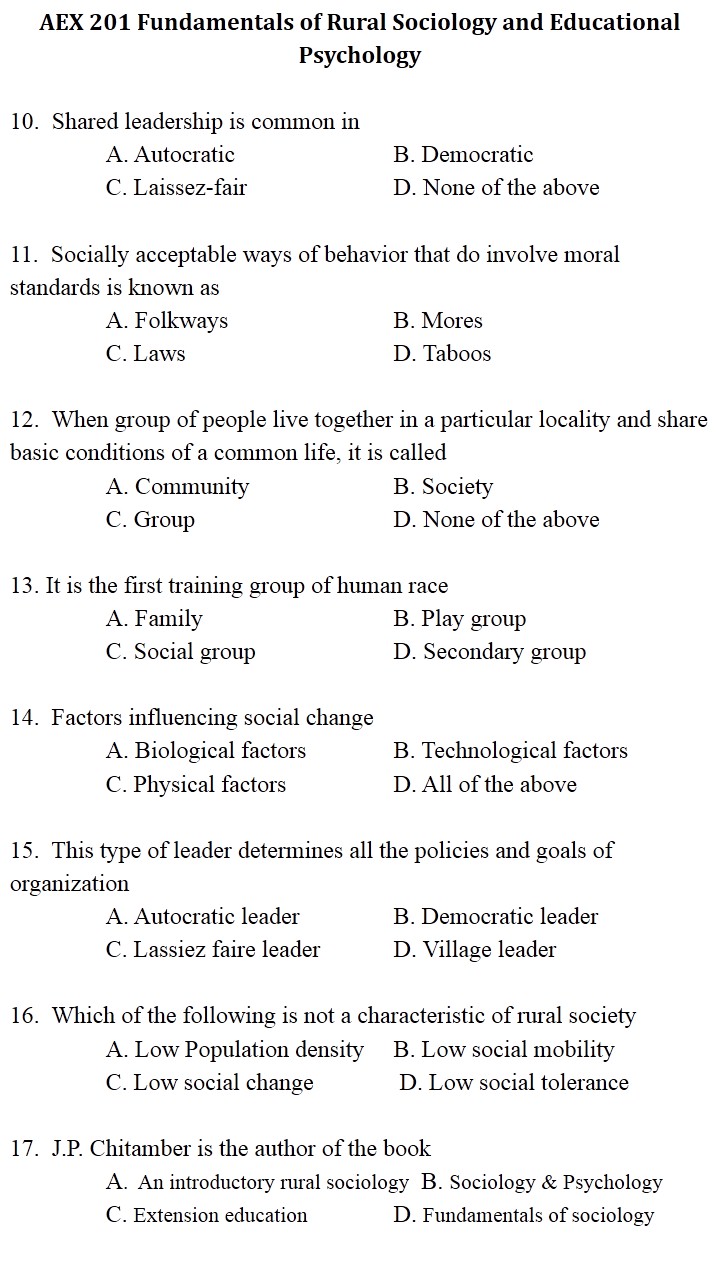
AEX101 Fundamentals of Rural Sociology and Educational Psychology - Objective questions (Till Mid semester)

AEX101 Fundamentals of Rural Sociology and Educational Psychology - Objective questions (Till Mid semester)

Research Safety and Research Integrity

Research safety in laboratories
                Laboratories provide hands on, minds on learning experience for optimal understanding of complex science concepts. Managing laboratory experiments require preparation, organisation, consistency and diligence.
            Carelessness in laboratories may lead to disaster because you are handling caustic chemicals, open flames and hot glassware. The following are the guidelines to be followed in the laboratory:
  1. Create a calm, focussed atmosphere. Make an organised and neat environment. The risk of confusion and accidents decrease when you know where to find equipment and have sufficient room to work. Establish consistent locations for specific pieces of equipment and chemicals.
  2. Be prepared. Preparation is a critical step to ensure success and safety in laboratories. Develop skills in lighting a Bunsen burner, using a pair of tongs etc. Learn how to use a fire extinguisher or fire blanket or eyewash station. Should be prepared to respond during emergencies.
  3. Wear appropriate clothing’s for laboratory work.
  4. Avoid unsafe behaviour.
  5. Familiarize with the procedure before beginning an experiment.
  6. Provide sufficient time for experiments. The potential for accidents increases when you rush through the experiment.
  7. Clean up after an experiment.

Research Integrity
Integrity is the quality of being honest, fair and good. Research integrity includes the traditional ideals of honesty, fairness and compliance with research guidelines and policies, as well as the goal of integrating one’s work as a researcher with one’s broader life experience and values.
For an individual research integrity means individuals commitment to intellectual honesty and personal responsibility. It is an aspect of moral character and experience.
For an Institution, it is a commitment to creating an environment that promotes responsible conduct by embracing standards of excellence, trustworthiness and lawfulness.
Why is research integrity so important?
Research integrity is the commitment to the trustworthiness of the research process by the greater scientific community. It is so important because the greater scientific community can only innovate and flourish when its members function together as a body to ensure a climate that promotes confidence and trust in our research findings, encourages free and open exchange of research materials and new ideas and acknowledges and respects the intellectual contributions of others in the greater community.
What does research integrity require of you?
As a Student researcher you need to do the following:
  1. Make thoughtful use of the research time by coming to the lab on time, prepared to work, not fooling around and not leaving early.
  2. Learning to use the equipment properly and following the standard operating procedures.
  3. Carefully recording all your work.
  4. Asking questions about anything you don’t understand, like procedures so that you are safe as well as others are also safe.
  5. Sharing your research results with other group members so that everyone can grow in collective wisdom.
  6. Respect all research group members by listening to their ideas.
  7. Accepting and owning your limitations rather than manipulating, erasing or in any manner altering laboratory data, when you encounter problems.
  8. Confronting and not ignoring suspected research misconduct happening around you.


********

AEX 101 Fundamentals of Rural Sociology and Educational Psychology -Descriptive Questions Model